
|
|
r

Bill introduced to stiffen worker protection laws
By Lisa Mascaro
Thu, Apr 23, 2009 (4:58 p.m.)
Sun Coverage
WASHINGTON --
House Democrats today introduced a sweeping bill to beef up worker protections
laws under the Occupational Safety and Health Act that lawmakers believe have
been too lax, leading to injury and death, including of construction workers on
the Las Vegas strip.
The Protecting
America’s Workers Act would stiffen fines for violations of workplace safety law
and create a new felony category for criminal violations. It also covers more
workers and adds protections for workers who disclose problems on the job.
Notably, the bill
would give workers and their families an avenue for challenging reductions in
fines OSHA assesses on employers. Those fines are often reduced during company
appeals.
“We found that far too many employers were subject to a slap on the wrist or even let off the hook when they put their employee in danger,” said California Rep. George Miller, chairman of the House Education and Labor Committee.
The bill was
introduced two years ago, but is even tougher this year as Democrats have
expanded their majority in the House and have a potential ally in the Obama
administration’s White House.
Democratic Rep.
Lynn Woolsey of California authored the bill, as she has previously.
“While thousands
of workers have been saved as a result of OSHA, 16 workers are killed and 11,200
workers are injured or made ill each and every day,” Woolsey said.
“This legislation
will strengthen OSHA by expanding coverage to millions of workers who are
currently unprotected or inadequately protected, increasing civil and criminal
penalties for those who violate the law, and by protecting those who blow the
whistle on unsafe employer practices.”
Woolsey said she
looks forward to partnering with Labor Secretary Hilda Solis “to ensure that
every American worker gets the protections that they deserve.”
The Las Vegas Sun’s stories about the high rate of fatality among construction workers on the Strip were cited last year as Congress debated the bill. The Sun’s investigation found a high rate of worker fatalities during the frenzied pace of building.
The Sun further
exposed how fines the state OSHA levied on employers were often substantially
reduced during appeals.
The legislation
would increase civil penalties for willful violations from a maximum of $70,000
to $120,000. For serious violations, the maximum penalty is increased from
$7,000 to $12,000.
The bill comes in advance of Workers' Memorial Day on Tuesday, which commemorates workers who have been killed on the job and focuses on efforts to make workplaces safer.
Labor secretary vows more focus on OSHA as stimulus projects begin
|
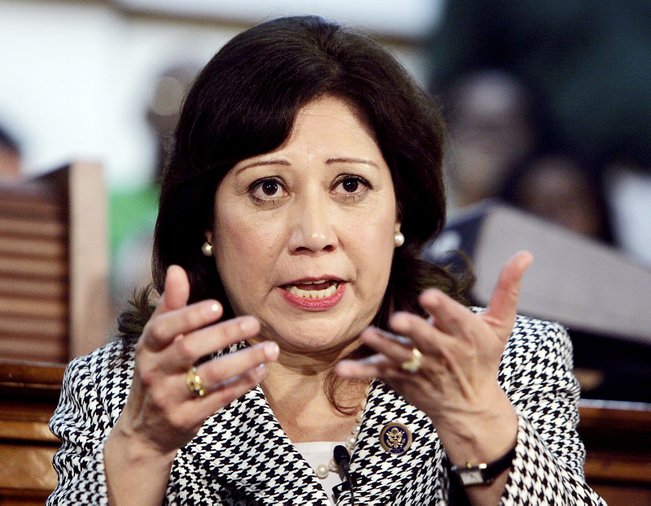
wilfredo lee / associated press file - Labor Secretary Hilda Solis has made hiring inspectors a top priority, but though the department said it would hire 250, Solis could not give a precise number Tuesday. |
By
Lisa Mascaro
Wed, Apr 22, 2009 (2 a.m.)
Washington — Labor Secretary Hilda Solis said Tuesday that the top priorities of
her department are hiring investigators and enforcing regulations on worker
safety and fair pay.
The previous administration had neglected those issues, Solis said in one of her first appearances on Capitol Hill.
Solis said the
focus on the department’s Occupational Safety and Health Administration as well
as its Wage and Hour Division is especially important now. Federal recovery
funding is launching construction projects that will need oversight to protect
workers.
“We’re looking at
really beefing up not just OSHA but Wage and Hour — those are really important
areas we know have been lacking,” Solis told reporters following a hearing on
green jobs at the Senate Health, Education, Labor and Pensions Committee.
“It’s going to be
more rigid, I would say, and more robust.”
Without mentioning
Las Vegas specifically or the many construction deaths on the Strip, Solis noted
the safety problems that industry in particular has faced.
“We’ve seen large
numbers of fatalities, injuries — that could be prevented — particularly in the
construction industry,” she said.
“My priority right
now is that we have seen where there is a great deal of concern of lack of
enforcement over the last few years at work sites — at worker safety and Wage
and Hour,” said Solis, a former California congresswoman.
Last year the Las
Vegas Sun detailed how construction workers had died at a rate of one every six
weeks on the Strip. The Sun also reported that state OSHA officials reduced
fines and withdrew citations after negotiations with employers over findings of
responsibility in the deaths.
More recently, a
Government Accountability Office report detailed shortcomings at the
department’s Wage and Hour Division, which investigates complaints over minimum
wage, overtime and other pay issues. Investigators found that complaints were
not handled properly, the Associated Press reported.
Solis could not
say Tuesday how many inspectors will be hired. But after the GAO report last
month, the Labor Department announced it was bringing on an additional 250
inspectors to “refocus the agency,” according to a statement from Solis.
At the time,
Solis’ statement said the department was in the process of adding 150
investigators to Wage and Hour Division field offices, and another 100
investigators “to ensure that contractors on stimulus projects are in compliance
with the applicable laws.”
The department
received $6.5 million for state and federal OSHA enforcement from the American
Recovery and Reinvestment Act.
The staff additions would increase the workforce by more than one-third and “will reinvigorate the work of this important agency, which has suffered a loss of experienced personnel over the last several years,” she said in the statement.
However, on
Tuesday, Solis also expressed concern that after years of budget cuts, the
department will face difficulty putting enough workers in place to handle the
flood of public works projects coming with stimulus dollars.
“Whether it’s highway, rail systems, water, sewage systems — all of that is going to require additional help,” she said.
“Our budgets have
been cut back so dramatically over the last eight years,” she said, adding she
may not have enough inspectors in the field.
“We’re going to have to be more targeted in our approach in how we go about doing these inspections. A lot of it will rely on the public and consumers who will notify our regional offices if they see something that’s wrong.”
